There’s a quiet myth in the rental business that profit comes from raising rent.
It sounds logical. Increase the monthly number, increase income. Simple math.
But in Baltimore’s current market, that equation rarely tells the full story. The landlords who consistently outperform are not the ones chasing small rent bumps every renewal cycle. They are the ones who understand that tenant retention in Baltimore rentals is often the real profit driver.
Turnover is expensive. More expensive than most owners want to calculate carefully.
When you start looking at Baltimore rental property profit strategies from a long-term perspective, retention begins to look less like a “nice-to-have” and more like a core financial strategy.
Let’s break down why.
The Hidden Cost of Turnover
When a tenant moves out, the loss is not just one month of rent. It’s layered.
- Vacancy days
- Marketing costs
- Leasing time
- Cleaning
- Repairs
- Potential upgrades
- Screening new applicants
- Risk of placing the wrong tenant under pressure
Even in strong neighborhoods, turnover can quietly eat into returns. In softer submarkets, it can erase an entire quarter’s gains.
Owners searching for practical guidance on how to reduce tenant turnover in Baltimore often focus on cosmetic improvements or pricing tweaks. Those matter. But they are only part of the picture.
The deeper issue is stability.
A stable tenant who pays on time, communicates clearly, and renews consistently creates predictable income. Predictability, in real estate, is power.
Why Baltimore Makes Retention Even More Important
Baltimore is a city of micro-markets. A rowhome in Canton behaves differently than a mid-rise near Johns Hopkins. A rental near major employers performs differently than one in a transitional area.
Because of that, tenant retention in Baltimore rentals plays a bigger role than many realize.
In neighborhoods with heavy student movement or short-term relocations, turnover is naturally higher. In family-oriented or professional corridors, stability is achievable with the right systems.
Understanding what today’s renters actually value is part of the strategy. When landlords ignore shifting expectations, renewals decline. That’s why analyzing what Baltimore tenants are really looking for in 2025 becomes more than a marketing exercise. It directly affects retention rates.
Retention is rarely about rent alone. It’s about experience.
The Math Most Landlords Avoid
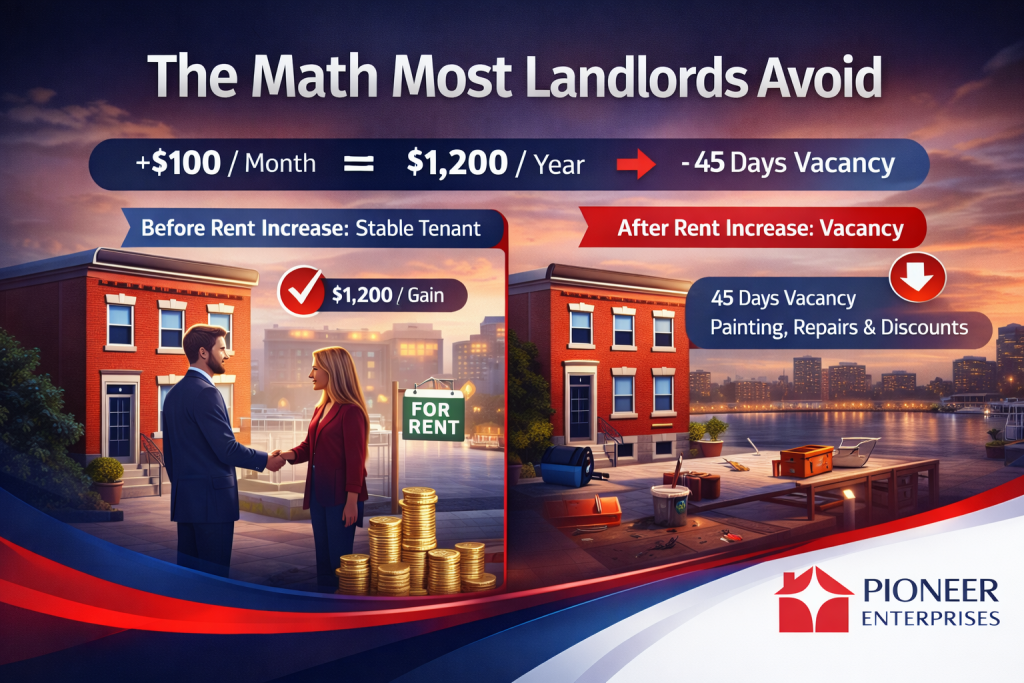
Let’s say you raise rent by $100 per month.
That’s $1,200 per year in additional gross income.
Now imagine that increase pushes a stable tenant to leave. You experience 45 days of vacancy. You spend on paint, cleaning, minor repairs. You discount the first month slightly to attract a new tenant quickly.
Suddenly, the math flips.
The smarter Baltimore rental property profit strategies often prioritize keeping strong tenants slightly below peak market rent rather than gambling on turnover.
Is this always true? No.
But experienced owners know that stability frequently outperforms small rent hikes.
Retention Starts at Screening
Retention is not just about renewals. It starts before the lease is signed.
Placing the right tenant reduces turnover risk dramatically. Screening for income stability, rental history, communication style, and realistic expectations creates better long-term results.
That’s why understanding what qualities make an ideal tenant is not theoretical. It directly connects to long-term profit. Tenants who align with the property and neighborhood stay longer.
On the other hand, ignoring warning signs can lead to expensive mistakes. Many landlords have learned the hard way after overlooking early red flags during tenant screening in Baltimore rentals.
Retention is built on selection.
The Experience Between Move-In and Renewal
Here’s where many landlords fall short.
They focus heavily on filling the unit. Then communication slows. Maintenance requests feel delayed. Inspections feel inconsistent. Expectations blur.
Tenants start browsing other listings long before renewal conversations begin.
Strong tenant retention in Baltimore rentals depends on structured communication. Quick response times. Clear lease terms. Consistent inspections. Transparent policies around deposits and pets.
Renewals are not won at the end of the lease. They are earned throughout it.
Landlords who actively focus on lease renewal strategies that keep Baltimore renters long term often see lower vacancy and more predictable income streams.
How Property Managers Reduce Turnover
This is where professional structure matters.
Property managers do not just collect rent. They create systems:
- Automated reminders
- Maintenance tracking
- Mid-lease check-ins
- Early renewal conversations
- Clear documentation
- Consistent enforcement of policies
These systems reduce friction. And friction is one of the biggest drivers of turnover.
When tenants feel heard and issues are handled promptly, they are less likely to explore alternatives. Especially in competitive submarkets.
Owners evaluating how to reduce tenant turnover in Baltimore often find that operational consistency, not rent discounting, makes the biggest difference.
Retention Also Protects Against Risk
There’s another angle that rarely gets discussed. Frequent turnover increases fraud exposure.
Each new placement introduces screening risk. Identity verification, income confirmation, background checks. Even experienced landlords occasionally encounter issues, particularly with the rise in digital application manipulation.
That’s why maintaining strong tenants reduces exposure to some of the patterns discussed in common rental scams affecting Baltimore landlords.
Fewer placements. Fewer risks. More stability. Retention quietly protects more than income.
Small Adjustments That Improve Retention
Not every solution requires major renovation. Often, improvements that support tenant retention in Baltimore rentals include:
- Faster response to maintenance requests
- Clear pet policies
- Transparent security deposit communication
- Fair renewal increases
- Clean, well-lit common areas
- Proactive seasonal maintenance
Simple upgrades, such as better lighting or small appliance replacements, can reinforce tenant satisfaction without straining budgets.
The goal is not perfection. It’s predictability.
When Raising Rent Still Makes Sense
Retention does not mean avoiding increases entirely.
Baltimore rental property profit strategies should reflect market conditions. In high-demand areas with rising comparable rents, gradual adjustments are reasonable.
But the timing matters.
Large, sudden increases often backfire. Incremental adjustments tied to clear communication perform better. Tenants who understand the reasoning behind changes are more likely to renew.
Again, this returns to relationship management.
The Long-Term Advantage
Landlords who prioritize tenant retention in Baltimore rentals often notice something subtle over time.
Their properties run smoother.
Their marketing costs decrease.
Their vacancy periods shorten.
Their stress levels drop.
Profit becomes less volatile.
In a market where Baltimore rental property profit strategies must adapt to economic shifts and employment changes, stability becomes a competitive advantage.
Retention is not flashy. It doesn’t always generate headlines. But it produces consistent returns.
And in real estate, consistency tends to win.
Final Thoughts
If you are evaluating how to reduce tenant turnover in Baltimore, the answer is rarely just pricing. It is systems, communication, screening, and proactive management.
Retention is not accidental. It is structured.
At Pioneer Enterprises, we work with Baltimore property owners to create predictable rental performance through screening discipline, consistent maintenance, and renewal strategy. If you are ready to shift from reactive leasing to long-term stability, we would be glad to talk through your current approach and where improvements might make sense.
FAQs
1. Why is tenant retention more profitable than raising rent?
A: Because turnover creates vacancy, repair, and marketing costs that often exceed the gains from small rent increases.
2. How can landlords reduce tenant turnover in Baltimore?
A: By improving communication, screening carefully, responding quickly to maintenance, and using structured renewal strategies.
3. Does keeping rent slightly below market make sense?
A: In many cases, yes. Stable long-term tenants often produce better overall returns than frequent turnover.
4. How does screening affect tenant retention?
A: Choosing financially stable and communicative tenants increases the likelihood of long-term occupancy.
5. Can property managers really improve retention rates?
A: Yes. Structured systems, consistent communication, and proactive maintenance reduce friction and improve renewal likelihood.